
A product concept can look successful in CAD and still encounter challenges when it reaches manufacturing or real-world use. Fit issues, unexpected loads, material behavior, assembly complications, and performance requirements can all expose weaknesses that were difficult to identify during initial design.
Concept validation and testing gives engineering teams an opportunity to evaluate those concerns before committing to tooling, equipment, materials, and full-scale production. By testing assumptions early, manufacturers can refine designs with greater confidence and reduce the likelihood of expensive changes later in the product lifecycle.
What Is Concept Validation & Testing?
Concept validation and testing is the process of evaluating whether a proposed product, component, or manufacturing approach is likely to meet its intended requirements before moving into production.
Validation can address several questions:
- Does the design perform its intended function?
- Can components be manufactured within the required tolerances?
- Are the selected materials appropriate for the operating environment?
- Will parts fit and interact as intended?
- Can the product be assembled efficiently and consistently?
- Are there potential failure modes that should be addressed before production?
The specific validation process depends on the product and application. It may include engineering analysis, physical prototypes, functional testing, material evaluation, dimensional checks, or multiple methods used together.
The objective is to replace assumptions with provenuseful engineering data.
Why Validate a Concept Before Production?
Decisions made during product development can have significant downstream effects. Once tooling has been built, suppliers have been selected, and production processes have been established, design changes become more disruptive and expensive.
Concept Validation & Testing creates an earlier checkpoint.
Engineers can evaluate critical design assumptions while there is still flexibility to make adjustments. A dimension that creates an assembly problem, for example, may be relatively easy to revise in the design phase. Discovering the same issue after components have entered production could lead to rework, scrapped material, tooling modifications, or schedule delays.
Early validation can help manufacturers reduce:
- Engineering change orders
- Tooling revisions
- Production interruptions
- Material waste
- Assembly complications
- Quality issues
- Unexpected product failures
For OEMs working under demanding launch schedules, identifying these issues earlier can also support a more predictable path from development to production.
4 Key Areas to Evaluate During Concept Validation & Testing
Effective validation should focus on the requirements that have the greatest influence on manufacturability, performance, and risk.
Functional Performance
A component needs to perform its intended function under realistic conditions. Depending on the application, testing may examine loads, movement, wear, temperature, environmental exposure, or interaction with mating components.
Testing functional requirements early helps engineers determine whether the concept behaves as expected before the design is finalized.
Materials
Material selection affects far more than the physical properties of a finished component. It can influence manufacturability, cost, durability, tolerances, and the processes required to produce the part.
Validation gives engineering teams an opportunity to confirm that proposed materials can support both performance requirements and the intended manufacturing method.
Fit and Assembly
Individual components may meet their dimensional requirements while still creating problems at the assembly level.
Tolerance stack-ups, fastening methods, component orientation, access for assembly, and mating interfaces should all be considered. Evaluating the complete assembly can identify opportunities to improve repeatability and simplify production.
Manufacturing Feasibility
A technically functional design still needs a practical production strategy.
Engineering teams should consider whether the proposed geometry, tolerances, materials, and processes are appropriate for the expected production volumes. This evaluation can reveal features that are difficult to manufacture consistently or requirements that add cost without providing meaningful functional value.
The Role of Prototypes in Concept Validation
Prototypes can provide valuable information that digital models alone cannot always capture.
Depending on the stage of development, prototypes may be used to evaluate overall geometry, component interfaces, assembly sequences, ergonomics, or functional performance. They can also help engineering teams compare alternative concepts before selecting a final direction.
A prototype does not necessarily need to duplicate the final production process to provide value. The appropriate prototype should answer a specific engineering question.
For example, one prototype might confirm physical fit, while another may be designed to evaluate material performance or a critical mechanical function. Defining the purpose of each prototype helps teams gather actionable information instead of simply producing a physical representation of the design.
Using Test Results to Improve the Design
Testing provides the most value when results feed directly back into engineering decisions.
If validation reveals excessive deflection, inconsistent fit, premature wear, difficult assembly, or another concern, engineers can investigate the cause and determine the appropriate design response. Changes might involve geometry, material selection, tolerances, component interfaces, or the manufacturing process itself.
This creates an iterative development cycle:
- Define the design requirements.
- Identify the most important assumptions and risks.
- Develop an appropriate validation method.
- Test the concept.
- Analyze the results.
- Refine the design where necessary.
- Revalidate critical changes.
Each iteration should increase confidence that the product is ready for the next stage of development.
Concept Validation as Part of Engineering Design & Analysis
Concept validation is most effective when it is integrated into the broader engineering process rather than treated as a final approval step.
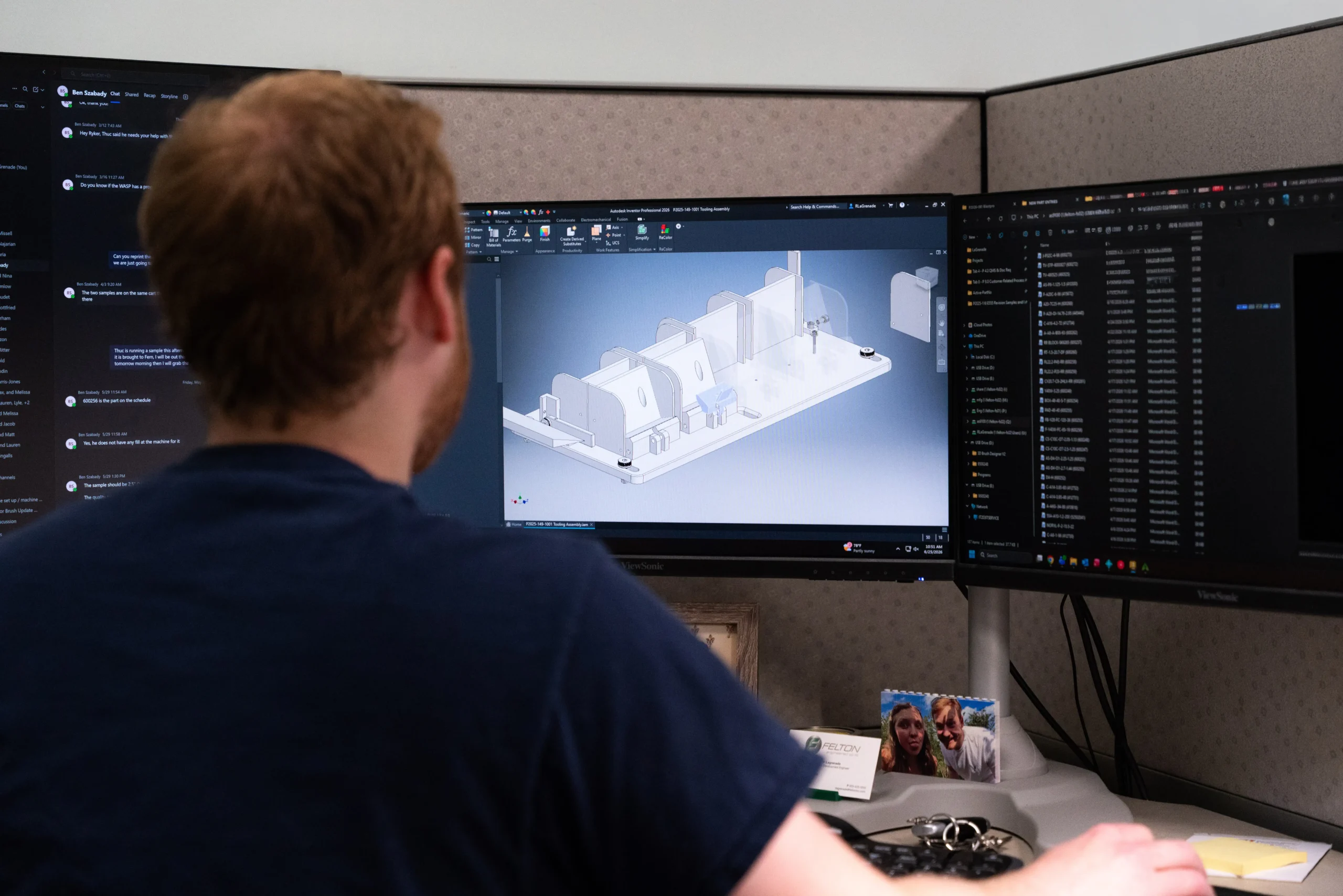
Engineering design and analysis can help teams examine how product requirements, materials, component geometry, manufacturing methods, and assembly considerations interact. Concept validation and testing then provides evidence that critical design decisions work as intended.
Together, these activities give manufacturers a more complete understanding of a product before significant production resources are committed.
Early collaboration with manufacturing partners can also uncover practical considerations that may be less obvious during product design. For example, seemingly minor dimensional or material decisions can affect repeatability and fit with mating components. Felton notes in its technical literature that dimensional differences can matter enough that a mating sample may be retained as an additional gauge to help ensure proper fit, illustrating the value of evaluating real manufacturing interfaces during development.
Build Confidence Before Production Begins
Concept validation and testing allows manufacturers to evaluate performance, manufacturability, materials, tolerances, and assembly considerations while changes are still manageable. The result is a better-informed design, a clearer production strategy, and greater confidence when the product moves toward manufacturing.
Felton works with engineering teams to develop customized solutions for application-specific requirements. Its technical resources demonstrate an emphasis on design flexibility and collaboration with product engineers, including customization of materials, dimensions, and configurations for specific applications.
For manufacturers looking to reduce development risk before committing to production, contact Felton to discuss your application, engineering requirements, and next steps.